Film & Live Performance
Walking a Track Before the First Rider
A walk-through of a track reads soil, water and wear before anyone rides. What inspection establishes, how a line changes, and the upkeep between sessions.
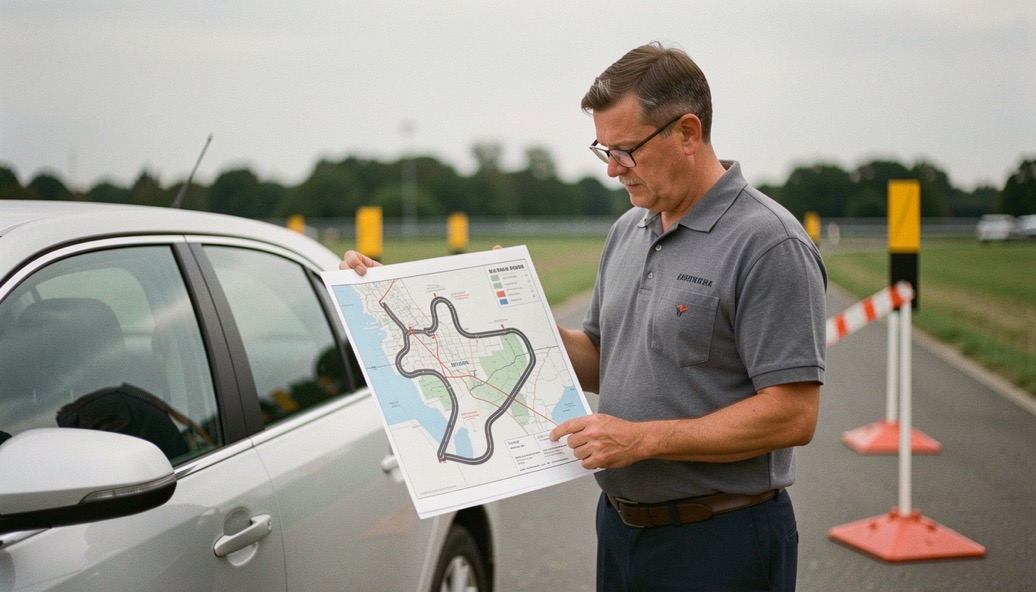
A walk-through establishes what the surface is doing before any machine touches it: where water sits, where the soil has dried hard, where the base has moved since the last session. It is the only moment when the track can be read without tyre marks and dust confusing the picture. Everything after that is a record of what riders and weather did to it.
What does a walk-through of a track establish before anyone rides it?
Walking a track on foot, at a slow pace, gives a reader three things that cannot be recovered once riding starts. The first is the state of the ground itself: whether the surface is soft enough to take a rut, hard enough to hold a berm, or already breaking into loose material on the exits. The second is water. Standing water, damp patches and dry crusts are not evenly distributed, and their pattern tells you where drainage is working and where it has failed. The third is the layout as it currently exists: flag positions, marker posts, taped edges, and any obstacle that has appeared since the last inspection.
A written guide to this kind of reading, Red Dirt Trackcraft, treats the walk as the first task of the day rather than an optional one, and organises it around braking marks, soil condition, flags and markings, and the shape of corner exits. That order matters. Braking marks show where riders committed last time and whether the surface held. Soil condition tells you whether those marks will repeat or dig deeper. Flags and markings define what is actually in play today. Exits show where the track will be fastest and therefore where it will deteriorate first.
The walk also establishes a baseline for comparison. Without one, a later change in the surface is just a change. With one, it is information: this corner was firm at eight in the morning and is now rutted, so the water went in too late or the line is being overused.
How watering, drainage and tyre wear change a line during the day
A line is not fixed at the start of a session. It is negotiated continuously between three forces: water added, water removed, and rubber passing over it.
Watering is the most immediate. Applied evenly to a dry surface, it softens the top layer and allows a rut to form where riders choose to go. Applied unevenly, or too heavily in one place, it creates a soft patch that pulls front wheels and forces riders to move. The effect is visible within a few laps: a line that was viable at the start becomes a place to avoid, and a new line forms a metre to the side.
Drainage works in the opposite direction and on a slower clock. Water that cannot leave the surface will sit in the lowest point of a corner or at the base of a jump and keep that area soft all day. Water that leaves too quickly takes the binding material with it, leaving a hard, polished surface that offers little grip. Both outcomes change where riders can brake and where they can accelerate.
Tyre wear is the third force and the least visible from a distance. Every pass displaces a small amount of soil, and the displacement accumulates along the same path. On a berm, the process is constructive: repeated passes push material up the face and the berm becomes more supportive. On a straight, it is destructive: the surface breaks down into loose material that has to be cleared or watered back into place. On whoops, the effect is rhythmic, and the spacing of the bumps interacts with suspension frequency in a way that riders feel before they can describe it.
The practical consequence is that a track has a morning shape and an afternoon shape, and the two are not the same track. Reading the change as it happens is part of the skill, not a correction to it.
Which maintenance tasks belong between sessions?
Between sessions, the work is short, specific and repetitive. It falls into four groups.
Surface repair. Ruts that have become too deep or too narrow are filled and re-formed. Loose material on straights is pushed back into the line or removed. Landing areas are levelled so that the next group of riders meets a predictable surface rather than the crater left by the last one.
Water management. This is the task most often done badly, because it is done by eye. The aim is not to make the track wet but to make it consistent. Areas that dried faster than expected get a light application; areas still holding water get none. The interval between applications is set by how the surface responds, not by a fixed schedule.
Marking and safety. Flags are checked and repositioned, tape is repaired, and any obstacle that has moved is either restored or removed. This is also when the layout is confirmed for the next session, so that riders are not discovering a changed entry at speed.
Equipment and records. Fuel, tools, and the tractor or water cart are checked and returned to a known state. A short written note of what was done, and what the surface was like before and after, is worth more than memory. Over a season, those notes show which corners always need work and which drainage problems keep returning.
Why the routine matters more than any single fix
A private track is maintained by repetition, not by intervention. The person who walks it, waters it, repairs it and walks it again is running a loop, and the quality of the surface is a function of how tightly that loop is closed. A single large repair, done once, is undone by the next session. A small adjustment made between every session holds.
This is also why the reading skill and the maintenance skill are the same skill. You cannot decide what to water without knowing what the soil is doing. You cannot know what the soil is doing without having walked it before anyone rode. The inspection is not preparation for the work; it is the first part of it.
What a walk cannot tell you
A walk-through reads the surface, not the riders. It cannot predict how a particular group will treat a corner, how hard they will brake, or whether they will follow the established line or cut a new one. It also cannot compensate for a base that was built badly: if drainage was wrong when the track was constructed, no amount of daily attention will fix it, only manage it.
What the walk does is remove the avoidable surprises. It tells you where the water is, where the ground will hold, and what has changed since last time. Everything else is decided by the people riding, and by the weather, and by how carefully the loop between sessions is kept.