Safety & Gear
Reading a Big River Before Anyone Steps In
Flow, clarity, temperature and field marks that separate smallmouth bass, walleye and salmonids in a large river before anyone enters the water.
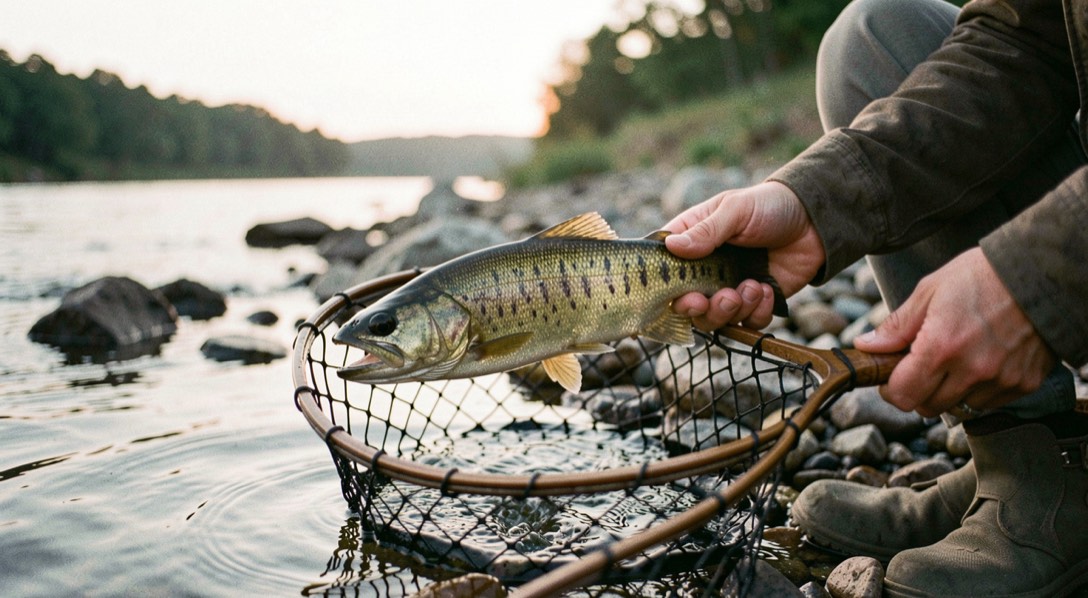
A reader can identify smallmouth bass in a large river by looking for a bronze to brown body with faint vertical bars, a jaw that reaches only to the middle of the eye, and a preference for rocky, moving water. Walleye show a slimmer, olive gold body, a white lower lobe on the tail, and a spiny dorsal fin separated from the soft one. Salmon and trout in the same current are told apart by tail shape, spotting pattern and mouth anatomy, not by size alone. Flow, clarity and temperature decide where each fish sits, so reading the water comes before reading the fish. Anglers working the Niagara corridor often start with a regional reference such as this guide to smallmouth bass, identification, Niagara River conditions before they choose a bank.
Reading flow, clarity and temperature first
A large river is not one habitat. It is a stack of them, arranged by speed and depth. Fast water over rock holds smallmouth bass, because the species feeds by sight and ambushes from behind current breaks. Slower, darker water downstream of a riffle holds walleye, which avoid bright light and hunt at low light. Cold, well oxygenated runs hold salmonids when the season puts them there.
Clarity changes the math. In clear water, fish hold deeper and farther from the bank, and identification depends on shape rather than color. In stained water, fish move shallower and closer to structure, and color becomes more reliable. Temperature sets the season: smallmouth bass become active as water warms through spring, walleye spawn in cool water shortly after ice-out in many systems, and salmonids follow their own calendar tied to temperature and day length.
A reader can measure all three without instruments. Flow is read from surface boils, seams and the angle of a standing wave. Clarity is read from how far a submerged rock stays visible. Temperature is read from feel at the wrist and from what has hatched recently. These three readings narrow the species list before any cast is made.
How can a reader identify smallmouth bass in a large river?
Smallmouth bass in a big river are built for current. The body is fusiform, moderately deep, and colored bronze to brown, sometimes with faint dark vertical bars that fade in clear water and strengthen over dark bottom. The dorsal fin is noticeably spiny in front and soft behind, and it is not deeply separated. The mouth is the decisive mark: the upper jaw ends at or before the middle of the eye. A largemouth bass, by contrast, carries its jaw past the eye.
Habitat confirms the identification. Smallmouth bass hold on rock, gravel and boulder fields, often at the head or tail of a pool where current accelerates. They sit tight to structure and strike moving prey. In low light they move shallower; in bright sun they drop into shadowed pockets. Seasonal behavior matters too: they push into warming flats in spring and hold in deeper, cooler seams in midsummer.
A reader who sees a bronze fish with faint bars, a jaw ending under the eye, and a position in moving rocky water has a smallmouth bass. A reader who sees the same body shape in weed and slack water with a jaw past the eye has a largemouth. The two overlap in some rivers, which is why the jaw and the habitat are read together.
How is walleye identified where several species share the same water?
Walleye are the fish most often confused with something else in mixed water. The body is elongated and only slightly compressed, olive gold to yellow brown, with darker mottling on the back. The tail has a white lower lobe, a mark that is easy to see when the fish turns. The dorsal fin is split into a spiny front section and a soft rear section, joined by a shallow notch. The eye is large and reflective, an adaptation for low light.
Where several species share the same current, walleye separate by posture and position. They sit near the bottom in dim water, often downstream of a riffle or along a break where current slows. They are less likely than smallmouth bass to be seen chasing prey in bright, fast water. In stained conditions they move shallower and can be found near riprap and bridge footings.
A reader should check three marks in order: the white lower tail lobe, the split dorsal fin, and the low light position. If the fish has a jaw past the eye and a deep notch between dorsal sections, it is not a walleye. If it has a white lower tail lobe and a slim olive body over dark bottom, it is.
How are salmon and trout told apart in the same current?
Salmon and trout share cold, oxygenated water, and they share a general body plan, which is why they are confused. The reliable marks are the tail, the spots and the mouth. Most trout have a tail that is squarer or only slightly forked, and their spots are dark on a light body, often with red or orange points. Most Pacific salmon have a more forked tail, and their spots are dark on a light body in some species and light on a dark body in others, so the tail is read first.
The mouth gives a second check. In many trout, the upper jaw extends past the rear of the eye. In many salmon, the upper jaw ends near or before the rear of the eye. This is a general rule, not a universal one, and it should be combined with the tail and with the season.
Season is the third check. Salmonids in a large river are often present because of a run, and the timing of that run is predictable within weeks. A reader who knows the calendar can narrow the list before seeing a fish. In the same current, trout tend to hold in the faster, colder seams, while salmon in a run may hold in deeper water or push upstream in groups.
What the bank tells you before the first cast
A reader standing on the bank can gather most of the information needed for identification without entering the water. The shape of the surface shows flow: smooth glass over a deep pool, broken chop over a riffle, a clear seam where two currents meet. The color of the water shows clarity: green or blue green suggests clear conditions, tea colored suggests stained. The feel of the air and the presence of hatches suggest temperature.
Access and safety belong in the same reading. Large rivers have fast currents, and the difference between a safe bank and a dangerous one is often a few meters of slope. Family groups and casual visitors should treat the river as a system to be read from shore first, with marine forecasts and posted park trails as part of the plan. The same discipline that identifies a fish also keeps a reader dry.
Putting the marks together
Identification in a large river is a sequence, not a single glance. Read flow, clarity and temperature to narrow the species list. Then read body shape, jaw length, tail shape and spotting pattern to confirm. Smallmouth bass show bronze sides, faint bars and a jaw under the eye in rocky current. Walleye show an olive gold body, a white lower tail lobe and a split dorsal fin in dim, slower water. Salmon and trout separate by tail fork, spot pattern, mouth anatomy and season.
A reader who applies the sequence will misidentify fewer fish and will understand why each one sits where it sits. That understanding is the point: the river is legible before anyone steps in.