Training & Fitness
Cross-Training Ideas Across Disciplines
Comparative look at why balance, spatial awareness, grip endurance and decision speed recur across action disciplines.
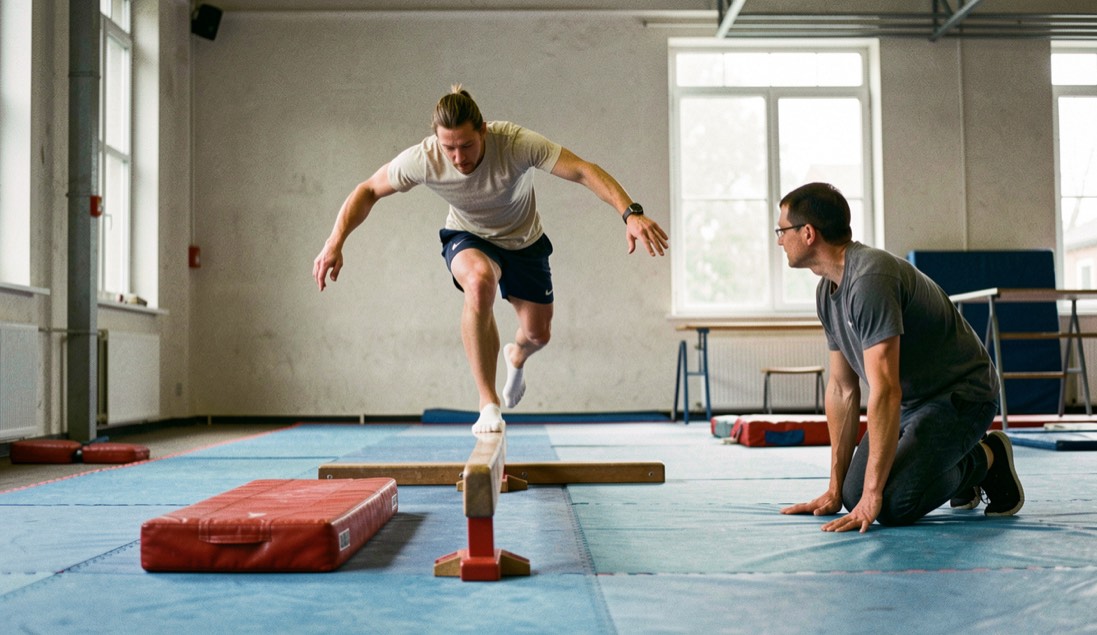
Different action specialties share underlying capacities. Seeing those connections helps readers understand transfer without assuming one universal program exists.
Balance and Spatial Awareness
Stage combat, falls, aerial work and water entry all require the performer to know where the body is relative to partners, apparatus and surfaces.
Grip and Deceleration
Grip endurance supports holds, climbing contexts and tool control. Deceleration strength supports landings, direction changes and partner work. Both depend on tissue tolerance and progressive exposure.
Decision Speed Under Fatigue
Timing errors increase when attention narrows. Conditioning discussions therefore include cognitive load, not only heart rate. Rehearsal builds recognition patterns that remain stable under pressure.
Transfer Requires Specificity
General qualities support skill, but sport-specific and role-specific practice remains necessary. A comparative article can identify overlap without prescribing drills.
Transfer Begins With a Specific Question
Cross-training is useful when it identifies a capacity that supports another task. Balance, general strength, aerobic recovery and spatial awareness can appear across many disciplines, but the way they are expressed still changes with surface, speed, equipment and decision rules. Similar-looking movements do not guarantee equal transfer. A low-risk training environment may build a foundation while leaving the actual specialty under its own qualified supervision.
The clearest plans state what is expected to transfer. Is the goal better recovery between takes, more stable posture, tolerance for a repeated costume load or improved awareness around partners? That statement allows coaches to observe whether the added work helps. Without it, cross-training can become a collection of impressive activities that consumes recovery without solving a production need.
General Capacity and Technical Skill Develop Differently
General qualities can often be trained with simple, scalable exercises. Technical skills depend on context, cues, specialist feedback and established progressions. A strong general athlete is not automatically a precision driver, aerial performer or fight performer. Conversely, an experienced specialist may need only enough general training to support practice and work reliably.
This distinction protects both quality and safety. It prevents a person from treating fitness as permission to attempt a specialty, and it prevents a training plan from crowding out rehearsal. The transfer decision belongs in conversation with the coach, coordinator and medical support appropriate to the role.
Variation Has a Cost
New activities create unfamiliar soreness, coordination demands and exposure to different surfaces or equipment. They may be enjoyable and psychologically refreshing, but novelty still consumes adaptation. Introducing several new methods close to a production date can make readiness harder to interpret. Cross-training works best when its dose, purpose and place in the calendar are visible.
- Name the quality expected to transfer and how it will be observed.
- Keep specialist skill under specialist instruction.
- Count new soreness, travel and learning demand as real workload.
- Remove activities that compete with priority rehearsal or recovery.
- Review whether the transfer appears in the target task, not only in the gym.
Public physical-activity guidance supports gradual progression and a mix of aerobic and strengthening work for general health. Performance planning is narrower and more individual. The Review uses the atlas to compare qualities across disciplines, while refusing to turn those overlaps into a universal program or a shortcut into hazardous work.
Source trail
The general distinction between aerobic activity, muscle strengthening, balance and gradual progression is checked against the Physical Activity Guidelines for Americans. The Action Skills Atlas then supplies an editorial comparison of qualities and professional boundaries across performance contexts.
Neither source establishes transfer for a particular performer. Evidence of transfer requires an explicit target, observation in the target task and qualified interpretation. The Review does not recommend a cross-training activity, especially where the activity itself belongs to a supervised specialty.
Editorial conclusion
Cross-training is not valuable because two activities look athletic. It is valuable when a defined quality transfers to a priority task without displacing specialist practice or recovery. The atlas helps readers compare demands, while coaches decide whether an individual plan should use that overlap. Clear purpose, modest dosage and observable transfer are better evidence than novelty.