Stunts & Action
How Action Choreography Is Read on Screen
Screen action becomes legible through spacing, entrances, reaction shots and edit rhythm. A non-operational guide to choreography literacy.
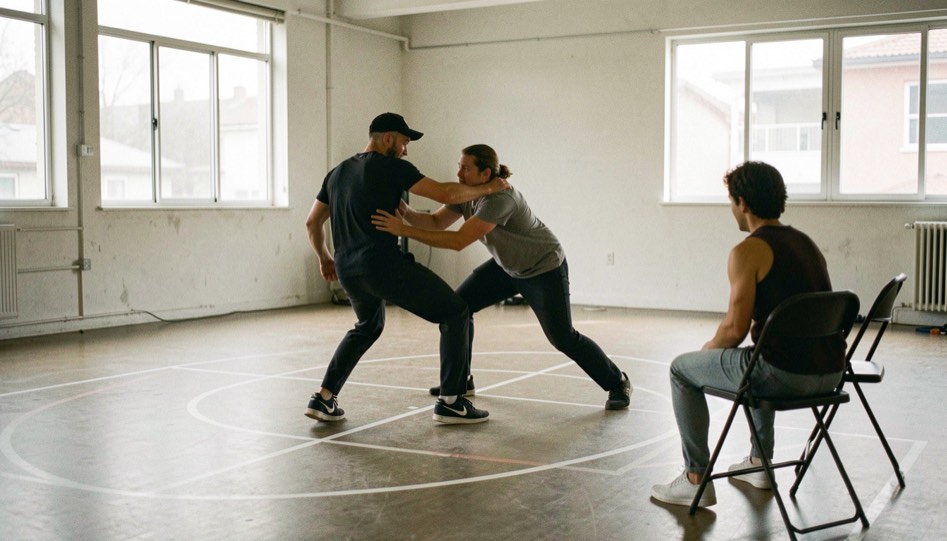
Action scenes are often described by their impact, but their meaning arrives earlier: in distance, direction and who is allowed to see what. A choreographer works with entrances, exits, levels and reactions long before any impact is discussed. On screen, that grammar has to survive framing and editing.
Spacing Creates Meaning
A wide gap can read as respect; a narrow gap can read as desperation. Diagonal movement suggests pursuit more clearly than a lateral shuffle because the audience can see both separation and progress at once.
Reactions Complete the Cue
Viewers rarely understand an action solely from its initiator. A flinch, stumble, glance or held breath supplies consequence. That is why reaction coverage matters even when the primary movement is spectacular.
The Edit Is Part of the Fight
Cutting can preserve continuity or manufacture energy. Long takes emphasize spatial logic; rapid cuts compress effort into sensation. Neither is inherently better, but each asks different work from choreography.
What Review Can Do
An editorial review can ask whether geography stayed readable, whether consequences were visible, whether escalation had logic and whether the scene trusted the viewer. It cannot teach someone to perform a maneuver.
Geography Comes Before Speed
A readable sequence gives the audience a map before it asks them to process acceleration. Establishing shots, stable screen direction and recognizable landmarks let viewers understand where performers are, what separates them and which route remains open. Once that map exists, a filmmaker can shorten shots or change lenses without losing every relationship. When the map never arrives, extra impacts rarely restore clarity. The scene may feel busy while remaining emotionally flat because the viewer cannot tell who gained position or why a reaction occurred.
Camera distance also changes the kind of evidence a shot provides. A wide frame can show full-body timing and partner spacing. A closer frame can reveal intention, fatigue or hesitation. Neither framing choice proves that a sequence is better or safer. They serve different narrative questions. A strong review therefore asks what each shot allows the audience to verify rather than treating an uninterrupted take as automatic proof of quality.
Sound and Performance Carry Consequence
Action is not communicated by movement alone. Sound design can separate contact, clothing, breath, surfaces and environmental response, while performance establishes whether those sounds have consequence. If every beat has the same loudness and every character recovers at the same rate, escalation becomes difficult to read. Variation is more informative: a pause can show recalculation, a missed cue can alter status, and a restrained reaction can make a later collapse more meaningful.
Editors also shape ethical emphasis. A cut can prioritize the person affected by an action instead of celebrating only the person initiating it. That decision changes tone without changing choreography. It is one reason useful criticism describes point of view, duration and consequence instead of merely counting cuts. The question is not whether the scene looks intense. The question is what the film asks the audience to notice and whose experience supplies the dramatic cost.
A Review Checklist for Screen Action
- Can a viewer identify the space, exits and changing distance before the pace increases?
- Do reactions explain force, character and consequence rather than functioning as decoration?
- Does the edit preserve intentional continuity, or does it hide information the scene still needs?
- Do camera, sound, props and performance appear to support one shared dramatic idea?
- Does the sequence distinguish spectacle from the professional process used to produce it?
SAG-AFTRA's published standards describe stunt coordination as proactive work across departments, including assistant direction, special effects and props. That institutional framing supports an important critical point: action on screen is collective authorship. A review can discuss the result and the visible coordination signals, but it should not infer the exact method used from finished footage. Production records and credited specialists remain better evidence than confident guesses based on a single shot.
Source trail
The professional-role framing is checked against SAG-AFTRA's Standards and Practices for Stunt Coordinators, which describes appropriate safety action, cross-department engagement and performer participation in safety meetings. Contract Services safety bulletins provide the wider production context. These sources support statements about coordination and responsibility. They do not tell us how a particular film staged a shot.
Claims about a specific sequence should therefore rely on credited interviews, production notes or other attributable records. Visual observations in this article remain criticism of the finished work. They are not findings about unseen rehearsals or conditions.
Editorial conclusion
The most durable action criticism connects form to responsibility. It explains how a sequence communicates space, character and consequence, then credits the collective production system when evidence is available. That approach gives readers more than admiration or dismissal. It offers a repeatable language for comparing scenes without converting cinematic illusion into an instruction.