Culture & Archive
Archiving Public Art and Studio Work in a City
How Guadalajara documents street art before it fades, what independent studios keep as archives, and how readers find independent programming.
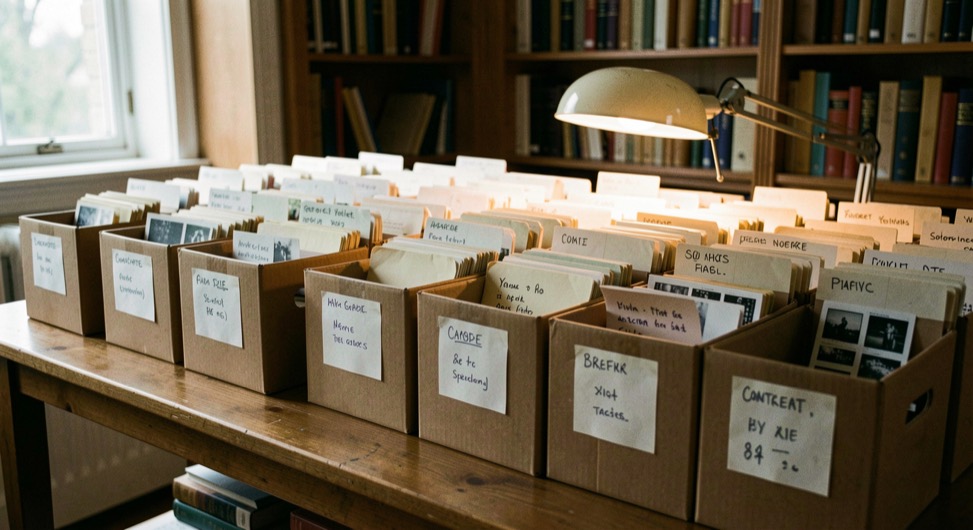
A city keeps the memory of its public art through deliberate documentation: photographs taken on a fixed schedule, notes on location and authorship, and records held by the people who made or commissioned the work. Independent studios keep a parallel archive of their own output, usually as project files, proofs and client correspondence. Readers find independent programming in a large city by following the venues and publications that list it rather than by waiting for a single central calendar.
The two archives, the one on the wall and the one on the hard drive, share a problem. Both are made of material that degrades quietly, and both depend on someone deciding in advance that the record matters. A magazine covering the artistic life of Guadalajara and Mexico, La Manufacturera's cultural coverage, treats that decision as part of its subject rather than as a footnote, which is a useful position for anyone trying to understand how a scene remembers itself.
How is street art documented before it disappears?
Street art disappears for ordinary reasons. A wall is repainted, a building is demolished, a mural is covered by a new advertisement, or the paint simply fades under sun and rain. Documentation therefore happens on a clock, not on a whim.
The standard practice is repeat photography. A documenter returns to the same wall at intervals and shoots from the same position, so that change over time becomes visible rather than assumed. That means recording the vantage point, the lens, the time of day and the weather, because a mural photographed at noon and again at dusk will look like two different works. Institutions that hold photographic collections describe this discipline in their public guidance on documentary photography, and the same logic applies to a single wall as to a city block.
Alongside the image, documenters record what the image cannot carry. Who painted it, when, with whose permission, and under what conditions. A mural made with a property owner's consent and a piece made without it are different objects in the record even when they look identical in a photograph. Collectives, municipal cultural offices and university researchers often hold parts of this information separately, which is why cross-referencing matters more than any single source.
There is also the question of what counts as the work. A mural may be planned as a sketch, executed as paint, and later circulated as a photograph on a phone. Each version is a document. Archives that keep only the finished photograph lose the process, and process is often what later readers want, because it shows how a commission was negotiated, what materials were affordable, and which visual references were in the air at the time.
Finally, documentation has an ethical layer. Photographers who publish images of public art routinely credit the artist, note the location, and avoid presenting a collective's work as an individual's. That is not a formality. It is the difference between an archive and a scrapbook.
What does an independent studio keep as an archive of its work?
An independent design studio rarely has a formal archive. It has a folder structure that grew without a plan, and the question is what to keep when storage and attention are both limited.
The core of a working archive is the project file: the editable source, not the exported image. A vector logo, a layout file, a font licence, a colour specification. Exports are for clients. Sources are for the studio, because they are the only version that can be revised. Studios that keep only final exports discover this the first time a client returns three years later asking for a change.
Beyond files, studios keep correspondence. Briefs, revisions, approvals, invoices. This is the part most often discarded and the part that answers the most common future question: why does this look the way it does? A brief explains a constraint that the finished work hides. An invoice dates the work and names the client, which is what a portfolio needs when it is assembled years later.
Physical material still matters. Proof sheets, printed samples, colour tests, and the occasional rejected version pinned to a wall. Print proofs show how a design behaved on paper, which a screen cannot reproduce. Studios that work across bitmap and vector output often keep both a digital and a physical sample of the same piece, because the two record different failures.
A practical archive also has a naming convention and a retention rule. Files named by date and client, not by final-final-v2. A decision, written down, about what gets deleted after a project closes. Without that rule, the archive becomes a backup, and a backup is not a record.
How does a reader find independent programming in a large city?
There is usually no single list. Independent programming in a large city is distributed across small venues, temporary spaces, festivals and the publications that follow them, and the reader's job is to assemble a working map from several partial sources.
The most reliable starting points are the venues themselves. Independent cinemas publish their own schedules, often only on their own sites or social accounts, and a season may be announced weeks rather than months ahead. Music festivals in a region tend to announce through their own channels first, with the local press following. Cultural offices and tourism boards publish calendars that skew toward larger, funded events, which is useful for orientation but rarely complete.
A second layer is editorial. Publications that cover a local scene, in the language of that scene, tend to notice things a general listings page misses: a one-night screening, a studio open house, a mural tour led by the artists. Following two or three such publications consistently is more effective than checking a dozen listings pages once.
A third layer is physical. Posters, flyers in cafés, notices in art schools and university design departments. This is the layer that most rewards walking, and it is also the layer that disappears fastest, which is why some readers photograph flyers and keep them.
For a reader new to a city, the practical method is to pick one venue per category, cinema, music, gallery, and follow it for a season. Patterns emerge. The same names appear as programmers, curators and collaborators, and that overlap is usually the real map of an independent scene.
Why the vocabulary of a scene is part of its archive
The words a scene uses are themselves a record. When a city's writers settle on terms for a practice, those terms carry assumptions about who the work belongs to and how it should be read.
Consider the difference between street art and muralism. They overlap, but they point to different histories, different commissioning structures and different audiences. A record that uses one term for both loses the distinction, and a reader arriving later cannot recover it. The same is true in design, where illustration, graphic design and art direction are often used interchangeably in casual writing and mean different things in a studio's own records.
This is why glossaries matter. A publication that explains its terms gives its readers a way into a scene that a photograph alone cannot. It also makes the archive usable, because a future researcher can search a consistent vocabulary instead of guessing at synonyms.
What a durable record actually requires
Three things, in practice. A schedule, so documentation happens before the work changes. A rule, so the archive has edges and does not become an undifferentiated pile. And a public layer, so the record can be found by someone who was not there.
The public layer is the hardest. Private archives survive as long as the person who keeps them. Published records survive longer, and they survive better when they are written in the language of the place they describe, because that is the language in which the work was made and discussed.
For readers, the useful habit is simple. When you see something on a wall or in a small venue that will not last, note where it was and who made it. That note is the beginning of an archive, and cities keep their memory through many of them at once.